Motia is an Argentine duo working at the intersection of analog synthesis and real-time visual art. Their performances — built around modular hardware and hand-crafted VJ systems — treat sound and image as a single continuous material rather than parallel disciplines. Since their formation in Buenos Aires, they have developed a collaborative methodology that refuses the clean separation between musician and visual artist: in a Motia set, neither role exists in isolation.
Artistic Practice
The work of Motia begins with the modular synthesiser as a generative instrument — not a tool for producing predetermined sounds but a system whose internal logic shapes the material in real time. Their compositional approach embraces indeterminacy within structure: patch configurations are prepared in advance, but the performance itself is not scripted. Voltage relationships between modules produce outcomes that the duo guides rather than dictates.
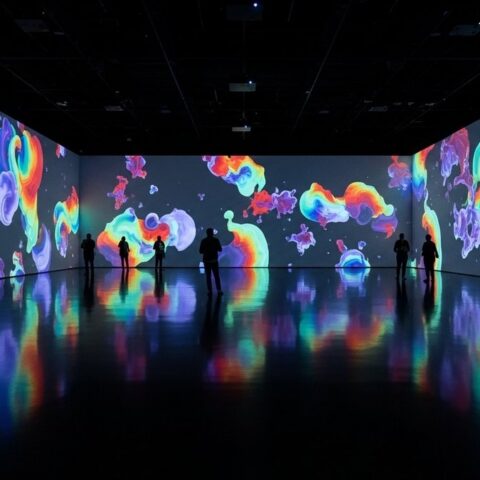
The visual dimension of their practice is equally process-driven. Rather than pre-rendered video material played back to accompany music, their VJ performances respond to the same audio signals driving the synthesis — meaning the image and the sound share a common electrical source. This approach, closer to expanded cinema than to conventional live performance, positions the screen as a resonant surface rather than a decorative backdrop.
Motia have been associated with the Buenos Aires electronic music underground, appearing in contexts that value craft and technical specificity over accessibility. Their practice sits within a regional tradition that treats modular synthesis not as novelty but as a sustained investigation — one that carries its own history of Argentine experimental electronics stretching back through earlier generations of sound artists.
Tools and Methods
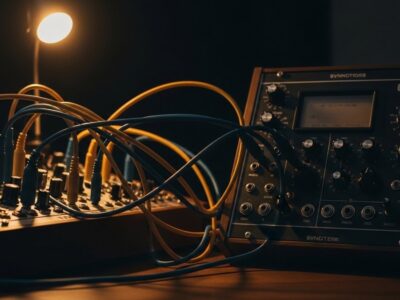
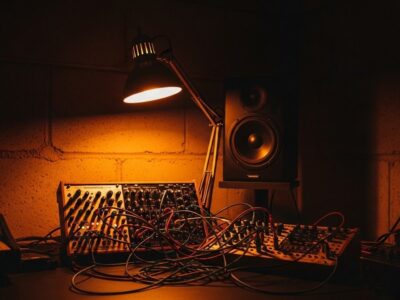
Their core setup is a Eurorack modular system configured collaboratively, with each member contributing modules that reflect their individual areas of focus. The system is not fixed: it evolves between projects as new modules are integrated and redundant ones retired. This ongoing reconfiguration is not merely practical — it is part of how the duo’s practice develops over time, each new system introducing new sonic possibilities and constraints.
For the visual component, they work with custom VJ software and hardware video synthesis, including analogue video processing techniques that introduce artefacts and degradations unavailable in purely digital workflows. The decision to retain these imperfections — noise, signal bleed, colour drift — is deliberate: it keeps the visual surface alive and contingent, resistant to the cleanliness that digital processing tends to impose.
Motia have spoken about the political dimension of working with analogue hardware in a cultural moment dominated by software: the physical weight of the equipment, the heat it produces, the irreversibility of certain patch decisions — all of these qualities restore a kind of bodily accountability to electronic music performance that pure software environments dissolve.
Selected Works
Their live audiovisual performances have been presented at electronic music and media art events across Argentina. Notable appearances include festival contexts in Buenos Aires where their real-time synthesis and video work has been documented as representative of the city’s contemporary modular scene. Their recorded output is deliberately limited: Motia have resisted the pressure to transpose their practice into a studio album format, arguing that the temporal specificity of live synthesis does not survive translation to fixed media without losing its essential character.
Within the Amplify DAI network — which connected experimental electronic artists from Latin America, the United Kingdom and Canada across its editions between 2018 and 2025 — Motia represent a strand of Argentine practice that foregrounds materiality and process. Their presence in that context positioned analogue synthesis and live visual art alongside digital and code-based practices, widening the frame of what counted as experimental electronic work within the programme.