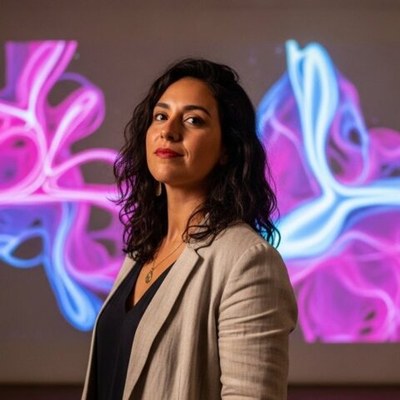
Erin Gee builds instruments from the body. The Montréal-based Canadian artist designs biofeedback devices that read galvanic skin response, heart rate, and breath — then route those signals directly into sound synthesis. The result is music that does not interpret emotion as subject matter but incorporates physiological affect as a technical parameter. Since 2006, Gee has developed a research-creation practice at the intersection of electroacoustic composition, voice, ASMR, and feminist technology, culminating in a collaboration with Magdalena Molinari through the Amplify DAI programme on the VR work Sensitive Superpositions.
Artistic Practice
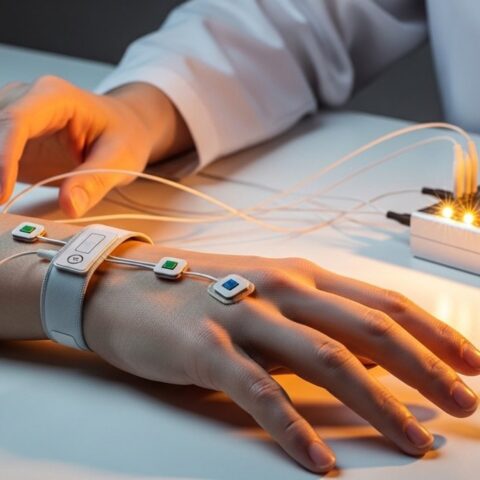
Gee’s work begins with a deceptively simple inversion: what if the body stops being an audience and becomes the instrument? Her central device, the BioSynth, reads physiological signals from performers or audience members — galvanic skin response, heart rate, respiratory rate — and translates them in real time into parameters controlling electronic sound synthesis. Emotional state and hardware are placed on the same technical level; the system does not represent feeling, it processes it.
This framework is grounded in a feminist critique of measurement. Her award-winning paper The BioSynth: an affective biofeedback device grounded in feminist thought (Best Paper, NIME 2023) argues that the apparent neutrality of biometric technologies is a construction — that bodily data has always been read through ideological filters, and that designing instruments with this awareness produces qualitatively different results. The paper is not a manifesto attached to the work; it is the theoretical architecture that makes the design decisions legible.
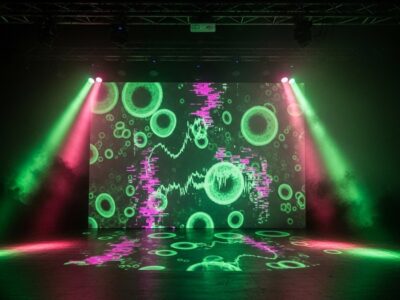
Her performance work Affect Flow (2022) stages this system over approximately thirty minutes, combining live electroacoustic music, verbal suggestion, and a hardware biosensor ensemble to induce non-naturalistic emotional states in participants. She describes the piece as initiating rather than documenting affect. The work has been presented at MUTEK Montréal 2023, SAT Montréal, Vancouver New Music, and Electric Eclectics Festival (Ontario). Her VR collaboration Sensitive Superpositions, developed through Amplify DAI with Magdalena Molinari, extends the biofeedback logic into immersive virtual environments, where bodily data shapes spatial and sonic architecture simultaneously.
Gee has been Associate Professor at the Université de Montréal Faculty of Music since 2024, where she supervises graduate and doctoral students. Her installation work has circulated through Ars Electronica, the PHI Centre Montréal, the Toronto and Karachi Biennales, ISEA, LEV Festival, NRW Forum, and Centro de Arte Sonoro (Buenos Aires). She co-founded the collective Audio Placebo Plaza in 2021 with Julia E. Dyck and Vivian Li.
Tools and Methods
The BioSynth is Gee’s primary instrument — a custom-designed device that processes biosensor inputs to control hardware synthesis in real time. It is not a product or a kit; it is an instrument she has built and continues to refine through the demands of her performance practice. Galvanic skin response (GSR) and heart rate data feed into synthesis parameters she has mapped through years of performer and audience testing.
Data sonification is not incidental to the practice — it is the compositional method. Gee works across hardware synthesis, neural networks (her collaboration with Sofian Audry used a model trained on Emily Brontë texts to generate whispered utterances from a 3D sound object), choral composition, and virtual reality platforms. Each technological strand is treated as producing a qualitatively distinct kind of affect rather than as interchangeable tools for achieving a pre-defined aesthetic outcome.
Her practice is funded by the Canada Council for the Arts, Conseil des arts et lettres du Québec, Conseil des Arts de Montréal, the Social Sciences and Humanities Research Council of Canada (SSHRC), and the Saskatchewan Arts Board — a funding portfolio that reflects the genuine intersection of her artistic and academic research activities. She was born in 1983 on Treaty 4 territory, Saskatchewan, and situates that origin explicitly within her work.
Selected Works
Sensitive Superpositions (2023–2024), developed through the Amplify DAI programme in collaboration with Magdalena Molinari, is a VR installation in which biometric data from the participant shapes both the sonic and spatial environment of an immersive virtual world. The work brings together Gee’s biosensor practice and Molinari’s visual and spatial research in a form that neither artist would have produced independently. It was presented as part of the Amplify DAI programme output at MUTEK and the PHI Centre.
Affect Flow (2022) remains her most performed live work — a thirty-minute electroacoustic performance using the BioSynth ensemble alongside verbal suggestion to initiate emotional states in participants. In Bloom (2023), commissioned by Productions Totem Contemporain, was written for singing bowl and live voice; it was premiered by Francis Leduc in Montréal in November 2023 and subsequently performed by Alkali Collective in Hamilton (2024). The BioSynth theoretical framework, published at NIME 2023, represents the most complete public articulation of the conceptual and technical principles underlying her instrument design.
See also: Amplify DAI resources on biosensor art and biometric interfaces.