France Jobin works at the quieter edge of electronic sound — building compositions from sine waves and the residue of specific places, seeking what she describes as the threshold between sound and silence. The Montreal-based artist has developed a practice over more than two decades that places her within a global network of sound artists and composers, while remaining rooted in a distinctly spare and considered aesthetic. Her work has been presented at Ars Electronica, MUTEK and Akousma, and released on the respected labels LINE and Room40.
Artistic Practice
Jobin’s compositional method is built on reduction rather than accumulation. Where much electronic music reaches for complexity and layering, her work strips back — using the sine wave as a primary material precisely because of its purity, its resistance to metaphor, and its capacity to produce spatial and perceptual effects without recourse to conventional musical gesture. The field recordings she incorporates are treated with similar restraint: they provide sonic context rather than narrative, placing the listener within a specific acoustic environment without demanding that environment carry meaning beyond itself.
This minimalism is not aesthetic asceticism for its own sake. Jobin has spoken and written about the way her practice engages with questions of presence, attention and the phenomenology of listening — concerns that are also central to her PhD research at Concordia University, Montreal. The research dimension of her practice is integrated rather than separate: the thinking that shapes the academic work and the thinking that shapes the compositions are, for her, continuous.
Her curatorial and pedagogical activities extend this approach. She has served as sound designer and collaborator on interdisciplinary projects and has participated as lecturer and workshop leader across Canada, Europe and Latin America — including at events connected to the Amplify DAI network.
Tools and Methods
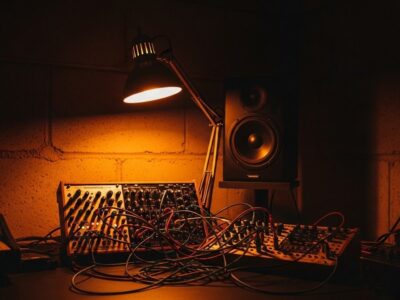
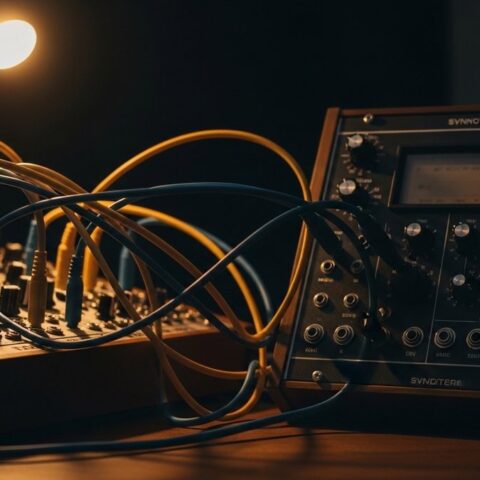
Jobin’s studio practice centres on software synthesis and digital signal processing, with sine wave generation at its core. Her field recording work involves careful selection of locations and a recording approach that prioritises acoustic character over dramatic content: she is interested in the specific qualities of a given space — its resonances, its ambience, its texture — rather than in capturing events. These two streams, the synthetic and the documentary, are then worked together in compositions that are typically slow-moving and carefully calibrated for spatial deployment.
The labels she has worked with are significant markers of her aesthetic position. LINE, founded by Richard Chartier in Washington DC, is one of the most consistently rigorous imprints in minimalist and microsound music; Room40, based in Brisbane, occupies a related but distinct territory in experimental electronic and electroacoustic work. Both have provided distribution frameworks well-matched to the sonic territory Jobin occupies.
Selected Works
The Music of Spaces (2023) is her most recent album — a document of her ongoing engagement with the relationship between acoustic environments and sine-wave synthesis. The title is characteristically direct: these are compositions made from and about the sonic qualities of space. Her earlier releases on LINE and Room40 established the parameters of this investigation, with each album representing a distinct iteration rather than a departure. Her installation work has been presented at festivals including Ars Electronica (Linz), MUTEK (Montreal and Buenos Aires) and Akousma (Montreal), situating her practice within both the international sound art circuit and the specific ecosystem of Montreal experimental music in which she has been an active figure.
Her PhD research at Concordia, examining the intersections between minimalism, perception and electronic composition, represents an ongoing formalization of questions that have been present in the work from the beginning.
[EMBED: Bandcamp — francejobin.bandcamp.com]