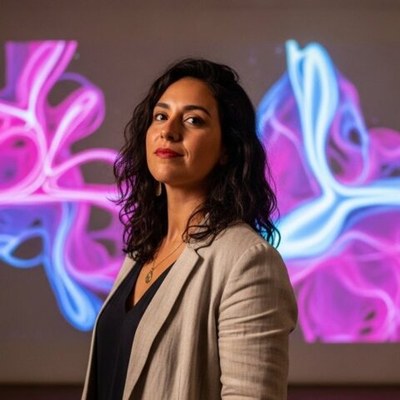
Magdalena Molinari trained as an architect and makes work with light. The transition sounds clean; the practice is anything but simple. Based in Buenos Aires and teaching at UNTREF, Molinari creates walkable, site-specific light installations that strip away narrative, symbol and reference in favour of direct sensory experience — spaces in which the programmed movement of colour and LED arrays is the content, not its vehicle. Her work has been shown at MUTEK, MACBA and Centro Cultural Recoleta, and she has collaborated internationally through Amplify DAI.
Artistic Practice
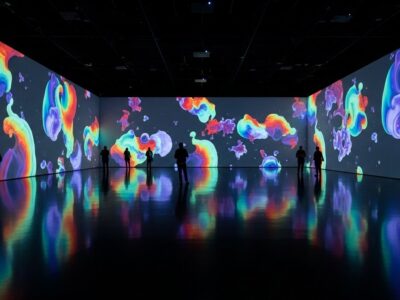
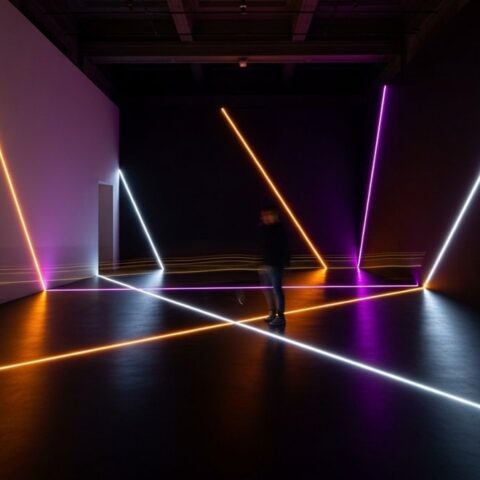
Molinari’s installations are conceived as inhabitable spaces rather than objects to be viewed. She has described the aim as generating “pure sensory experiences that omit all identification or association with the known” — a formulation that clarifies both what the work does and what it deliberately refuses to do. There is no narrative arc, no symbolic referent, no invitation to interpret. The work operates at the level of perception: colour, rhythm, scale, the way light changes a room’s volume and the body’s sense of its position within it.
Her architectural training is present not as a set of formal habits carried over into a new medium but as a particular way of thinking about space and the body within it. Where architecture typically organises space for function, Molinari’s installations organise it for sensation. This distinction — which she has explored theoretically in her master’s thesis and in workshops — is the conceptual engine of the whole practice.
In 2017 she held a residency at Sporobole, the centre for current arts in Sherbrooke, Quebec, where she developed a system for translating digital image into physical light — research that became foundational to subsequent teaching and project development. The international dimension of her practice has been sustained through Amplify DAI connections, including the VR collaboration Sensitive Superpositions with Canadian artist Erin Gee.
Tools and Methods
Her technical approach operates across three layers: the programming of electronic systems for LED device control, digital image and video processing, and — in more recent work — virtual reality as an extension of the installation space. These are not separate toolsets applied to separate problems; they are different facets of a continuous investigation into how digital information can be made material as light and spatial experience.
The workshops she has run — Pantallas Analógicas (2018–2021) and El Píxel Aumentado (2019–2022) — represent the pedagogical dimension of this investigation, translating her research into formats that engage other practitioners. Both focused on the conversion of digital image into physical light, and both were run at UNTREF, where she teaches in the Master’s programme in Electronic Arts. She also teaches at FADU-UBA and Universidad Di Tella.
Selected Works
Sensitive Superpositions (2021–2022), developed with Erin Gee through Amplify DAI, is her most widely documented international project: a virtual reality collaboration combining architectural principles, VR technology and music to create an immersive collaborative space. The work brought together Molinari’s light-and-space practice with Gee’s biofeedback and electroacoustic research in a way that neither artist could have produced independently. The Thickness of the Atmosphere (2020) — her master’s thesis work at UNTREF — gathered light installation, video and digital drawing into a single piece that functions both as completed artwork and as theoretical statement. More recently, Rojo Fulgor (2025) was a site-specific installation in Santiago, Chile, and Hacer un paisaje (2026) was presented at the Centro Cultural Ex Correo Central in Buenos Aires — evidence of a practice that continues to expand geographically while remaining anchored in a consistent conceptual framework.
For further profiles of artists working with installation and electronic arts, see the Amplify DAI artist directory.